 English
 Arabic
 French
 Haitian Creole
 Khmer
 Lao
 Myanmar (Burmese)
 Portuguese
 Spanish
 Swahili
 Vietnamese

Early Childhood Ages 3-5
Early childhood is a crucial time for brain and body development. More than 1 million new neural connections are formed every second (Center on the Developing Child), making these early years an important opportunity to lay the groundwork for healthy development. Building strong, positive relationships with parents and caregivers helps children develop a sense of security, trust, and connection.
Early prevention can also help establish healthy habits and attitudes around substances while building a foundation for positive decision-making. These skills extend far beyond substance use—they shape how children learn to manage emotions, build relationships, solve problems, respond to challenges, and make healthy choices throughout their lives.
For children ages 3–5, open conversations, patience, and reassurance help build strong bonds and trust. Simple things like asking about their day, setting clear boundaries, answering their questions, and letting them know they can always come to you lay the foundation for healthy relationships. Small conversations now can lead to big trust later.
At this age, Substance Use Disorder (SUD) prevention starts with teaching children about safety in simple, age-appropriate ways. For example, if you drop a pill on the floor, explain that it is not theirs to touch or put in their mouth. Help them understand that even vitamins or medicines that look like candy or animals are not safe for them to take on their own.
Teach children that medicine should only be given by a trusted adult with permission from a parent or caregiver. You can also explain that a medicine bottle with their name on it is intended for them, while medicine belonging to someone else is not safe for them to take.
Most importantly, help them understand that something that may be safe for an adult is not necessarily safe for a child. These simple lessons create a foundation for making safe choices as they grow.
It is easy at this age to establish a certain amount of control, but as they age this control can become a barrier. Begin with conscious conversations that build connection and trust early, NOT control.
Tips for talking to your child (Ages 3-5):
- Listen and be present. Give your child your full attention and show them what they have to say matters. Get on their level and make eye contact.
- Ask open-ended questions. Instead of just asking “How was your day?”, try “What was the best part of your day?”
- Name and validate feelings. Help your child put words to their emotions and let them know all feelings are okay.
- Keep conversations simple. Use age-appropriate language and answer questions honestly.
- Use everyday moments. Mealtimes, car rides, playtime, and bedtime can be great opportunities to connect.
- Model healthy communication. Show your child how to express feelings, listen, solve problems, and respectfully set boundaries.
- Connect before you correct. When your child is upset or struggling, offer comfort and understanding before addressing the behavior.

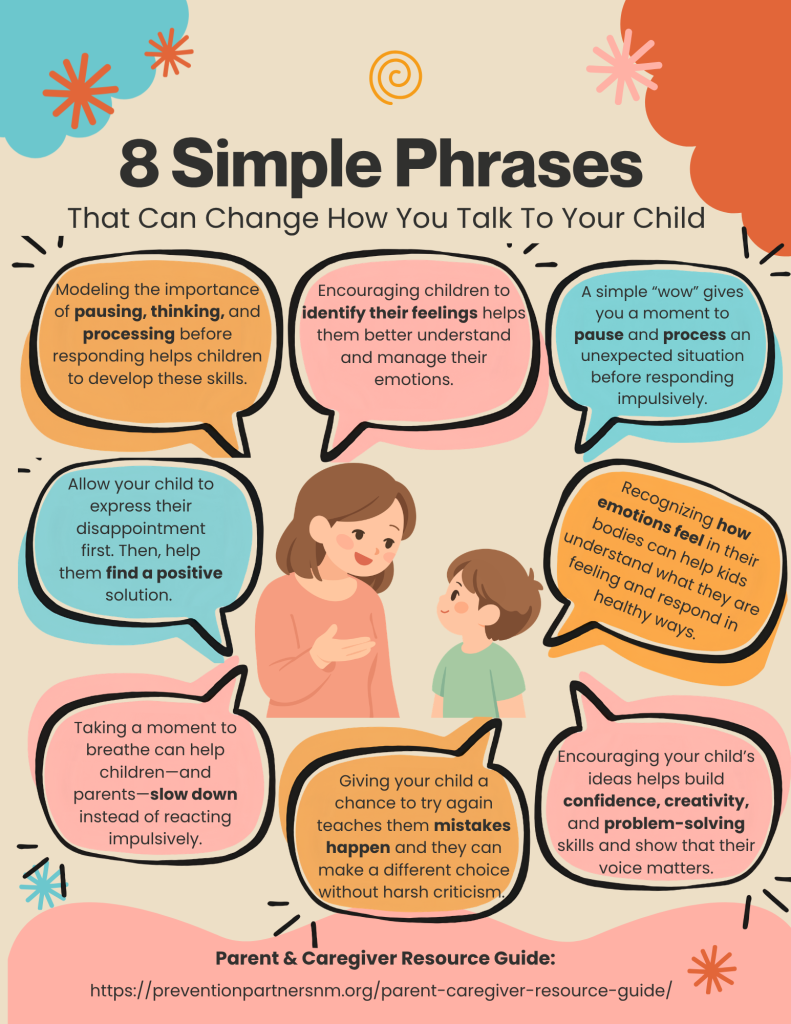
8 Simple Phrases Can Change How to Talk with Your Child:
- “I need to think about that.” Modeling the importance of pausing, thinking, and processing before responding helps children develop these skills for themselves.
- “How does that make you feel?” Encouraging children to identify and talk about their feelings helps them better understand and manage their emotions.
- “Wow.” Sometimes, a simple “wow” gives you a moment to pause and process an unexpected situation before responding impulsively.
- “Let’s see if we can find some good in this.” Allow your child to experience and express their disappointment first. Then, help them look for a positive solution, or lesson in the situation.
- “Listen to your body.” Teaching children to recognize how emotions feel in their bodies can help them better understand what they are experiencing and respond in healthy ways.
- “Let’s take a breath together.” Taking a moment to breathe can help children—and parents—slow down, manage big emotions, and respond thoughtfully instead of reacting impulsively.
- “Would you like a do-over?” Giving your child the opportunity to try again teaches them that mistakes happen and that they can make a different choice without shame or harsh criticism.
- “That’s a great idea!” Encouraging your child’s ideas helps build confidence, creativity, and problem-solving skills while showing them that their voice matters.
What Does Prevention Look Like at This Age?
It may seem early to think about substance use prevention, but prevention starts long before children are faced with those choices. At ages 3–5, prevention is about building strong, positive relationships through open communication, trust, healthy boundaries, and emotional support. Having age-appropriate conversations about medication is a great way to establish healthy habits that will last into adolescence. Some suggestions are:
- Medicine is not candy. Explain that medicine is made to help them feel better, but can make others sick.
- Show them their name on the bottle and remind them that it is made just for them. Explain that medicine can help us feel better when we’re sick, but can hurt us if taken by the wrong person.
- Only a trusted caregiver gives medicine. Teach them not to take medicine on their own.
- Be extra careful with vitamins. If they look or taste like candy, remind your child they can get sick from taking too many.
- “Don’t put it in your mouth unless it comes from a trusted grown-up.” Toddlers are curious and may mistake colorful or unfamiliar items for food.
Prevention starts early—with connection, confidence, and skills that last a lifetime.
Additional Resources
Playing is how Toddlers Learn: https://www.healthychildren.org/English/ages-stages/toddler/fitness/Pages/Playing-is-How-Toddlers-Learn.aspx
- Play is how your toddler explores and learns about the world as they grow and develop.
- As a parent or caregiver, you can support and encourage this play. Allow your child lots of time to play, and join in the fun when you can!
- Play is how young children start to get ready for school.
Age Appropriate Conversations:
- Talk Substance: https://www.talksubstance.org/talk/the-importance-of-communication/age-appropriate-conversations/
Starting the Conversation with Kids- The Kids Mental Health Foundation