 English
 Arabic
 French
 Haitian Creole
 Khmer
Khmer Lao
Lao Myanmar (Burmese)
 Portuguese
 Spanish
 Swahili
 Vietnamese
The Teen Years (Ages 13-18)
Positive Childhood Experiences (PCEs) can promote healthy development and help buffer the effects of adversity. Massachusetts highlights four building blocks that communities and families can strengthen:
- Nurturing, supportive relationships with family, peers, and trusted adults.
- Safe, stable, and equitable environments at home, school, and in the community.
- Social and civic engagement that creates belonging and connectedness.
- Opportunities for social and emotional growth, including decision-making, coping, communication, and resilience.
For teens, this can look like knowing there is an adult who will listen, feeling accepted at home, belonging at school, participating in a team or community activity, having mentors, and being given appropriate opportunities for independence.
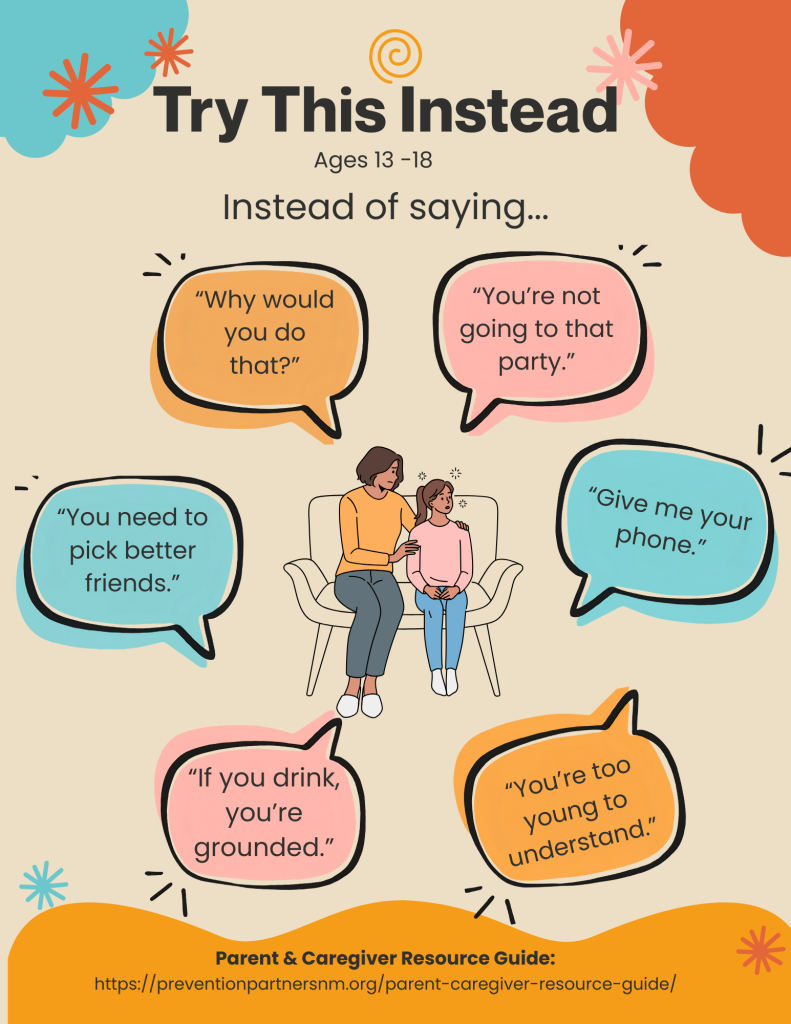
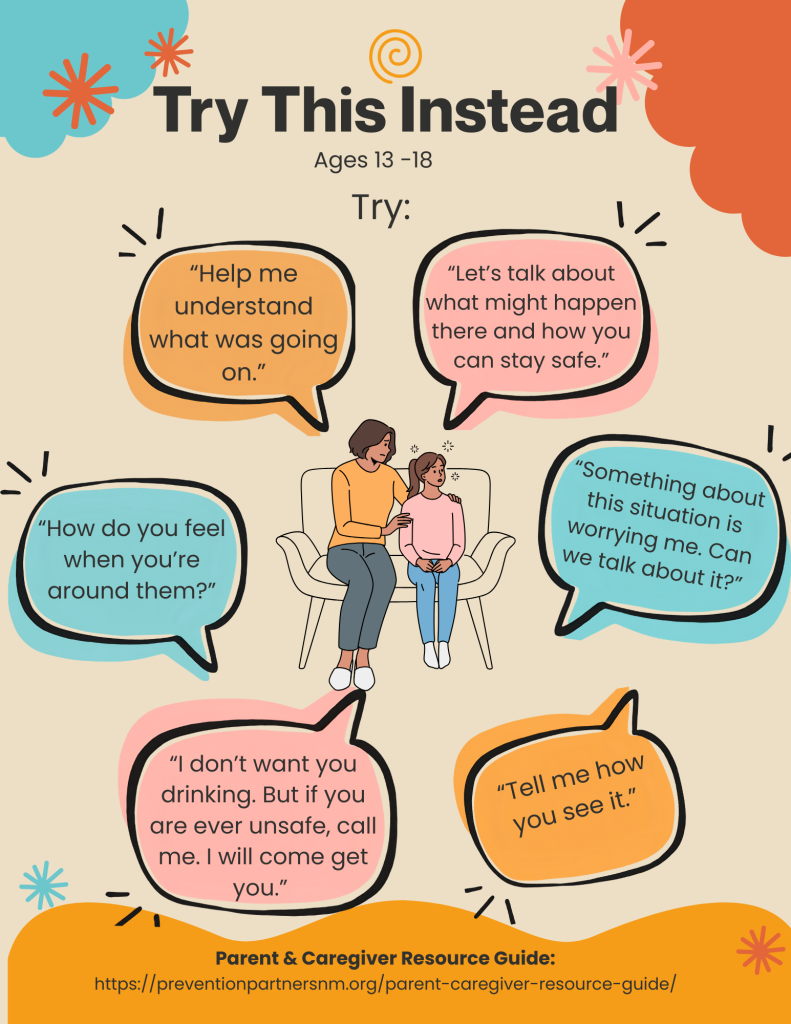
10 Ways to Stay Connected With Your Teen
Ask — and actually listen. Try: “Do you want me to listen, help you figure it out, or give you advice?”
Make conversations part of everyday life. Talk in the car, while cooking, on a walk, after practice, or while getting food. Small conversations make bigger conversations easier.
Get curious before getting angry. Start with: “Help me understand what happened.” Understanding is not the same as approving.
Know their world. Learn about their friends, school life, interests, music, games, activities, and online world because those things matter to them.
Create predictable time together. A meal, weekly drive, coffee run, show, walk, or other routine can create connection without forcing a serious conversation.
Notice the good. Point out effort, kindness, responsibility, growth, creativity, and the ways your teen contributes.
Let them practice independence. Give teens age-appropriate opportunities to choose, problem-solve, take responsibility, and learn from mistakes.
Help them build a network of trusted adults. Coaches, teachers, counselors, relatives, mentors, employers, and community leaders can all be protective relationships.
Set boundaries with a reason. Clear expectations still matter. Explain the safety or value behind a rule and involve your teen in problem-solving when possible.
Keep the door open. Make sure your teen knows: “If you are ever unsafe, call me. We will deal with everything else after I know you are safe.”
Talking About Alcohol, Cannabis, Vaping & Other Drugs
Do not wait until you suspect substance use to start talking. SAMHSA recommends many short, ongoing conversations and emphasizes that parents should communicate care, clear expectations, reliable information, awareness, and practical strategies for avoiding risky situations.
- Conversation starter: “What do kids your age think about vaping or cannabis?”
- Conversation starter: “Do people drink or use substances at the parties you go to?”
- Conversation starter: “What makes it hard for someone to say no?”
- Conversation starter: “What would you do if a friend became sick after using something?”
- Conversation starter: “If you were somewhere unsafe, who would you call?”
Parents and caregivers can also reduce access and harm by safely storing medications and substances in the home, properly disposing of unused medications, learning about current youth substance-use trends, and keeping naloxone available when appropriate.
Build Their Circle of Support
Ask your teen: “Who are five people you could go to if you needed help?” Their circle might include:
- Parent or caregiver • sibling • grandparent • aunt/uncle • teacher • counselor
- Coach • mentor • friend’s parent • doctor • employer • faith/community leader
A teen having several trusted adults is a strength. Supportive relationships outside the immediate household can add another layer of protection and belonging.
Belonging Is Prevention
Help your teen find places where they feel useful, accepted, and connected. Possibilities include:
- Sports, arts, music, cultural groups, student clubs, after-school programs, and recreation.
- Volunteering, community service, youth leadership, mentoring, faith communities, and employment.
- College/career exploration, internships, skill-building programs, and community health initiatives.
Digital Life & Social Media
Instead of focusing only on screen time, stay curious about what your teen experiences online. Talk together about:
- Privacy, location sharing, online relationships, scams, exploitation, and sharing images.
- Cyberbullying, comparison, body image, substance-related content, and how social media affects mood.
- Sleep and nighttime phone use, family expectations, and what to do if something online feels unsafe.
Try asking: “Does social media ever make you feel worse about yourself?” or “If something online made you uncomfortable, would you feel like you could tell me?”
Healthy Relationships
Talk about respect and consent before there is a problem. Healthy relationships should include trust, communication, boundaries, independence, safety, and the ability to say no. Controlling someone’s phone, passwords, clothing, friendships, or whereabouts is not the same as caring about them.
Mental & Emotional Well-Being
Adolescence includes normal changes in mood and independence, but caregivers should pay attention to significant or persistent changes in behavior, sleep, relationships, school performance, interests, substance use, or expressions of hopelessness or self-harm. You do not need to diagnose the problem before seeking support.
A connection-first opener: “I’ve noticed you haven’t seemed like yourself lately. You’re not in trouble. I just want to know how you’re doing.”
Additional Resources:
SAMHSA — Talk. They Hear You. — Parent and caregiver tools for starting and continuing conversations about alcohol and other drugs, including Five Conversation Goals, fact sheets, brochures, and discussion resources. Learn more
Massachusetts — Positive Childhood Experiences (PCEs) — Information for families and community members on relationships, safe and stable environments, belonging, and social-emotional growth. Learn more
Massachusetts — Creating Positive Experiences for Children — Practical ideas for building strong relationships, engaging in positive activities, creating safety, and supporting well-being. Learn more
HealthyChildren.org — American Academy of Pediatrics — Evidence-informed parenting and adolescent health information, including communication, substance-use prevention, mental health, digital media, and healthy development. Learn more
Sources & Further Reading
The guidance in this resource guide was informed by the following public-health, pediatric, prevention, and local community resources:
- Massachusetts Department of Public Health. Information for community members about Positive Childhood Experiences (PCEs). https://www.mass.gov/info-details/information-for-community-members-about-positive-childhood-experiences-pces
- Massachusetts Department of Public Health. The Power of Positive Childhood Experiences. https://www.mass.gov/the-power-of-positive-childhood-experiences
- Massachusetts Department of Public Health. Creating positive experiences for children. https://www.mass.gov/info-details/creating-positive-experiences-for-children
- Substance Abuse and Mental Health Services Administration (SAMHSA). Talk. They Hear You. Parent & Caregiver Resources. https://www.samhsa.gov/substance-use/prevention/talk-they-hear-you/parent-resources
- SAMHSA. Five Conversation Goals: Talk. They Hear You. https://www.samhsa.gov/substance-use/prevention/talk-they-hear-you/parent-resources/conversation
- American Academy of Pediatrics / HealthyChildren.org. Teen health and parenting resources. https://www.healthychildren.org/English/ages-stages/teen/Pages/default.aspx
- Growing up Drug Free https://www.getsmartaboutdrugs.gov/sites/default/files/2024-08/GUDF_2024_FINAL_508.pdf
- The Importance of Communication-Substance: https://www.talksubstance.org/talk/the-importance-of-communication/